Enter your email address to get free cooking tips & recipes direct to your mailbox:

Delivered by FeedBurner

Showing posts with label Filipino cuisine. Show all posts

Tuesday, May 31, 2011

Chinese Style Chopsuey


Girl+Talk+Crowdsurfing
Roasted Duck with mixed greens. Image by avlxyz


Chop suey (literally means "assorted pieces") is a Chinese dish consisting of meats (often chicken, fish, beef, shrimp (UK: prawns) or pork) and eggs, cooked quickly with vegetables such as bean sprouts, cabbage, and celery and bound in a starch-thickened sauce. It is typically served with rice but can become the Chinese-American form of chow mein with the addition of stir-fried noodles.


Chinese Style saucy Chopsuey. Image by SDeluz


Chop suey has become a prominent part of American Chinese cuisineFilipino cuisineCanadian Chinese cuisineIndian Chinese cuisine, and Polynesian cuisine


I love chopsuey! This is my favorite dish of all time and I especially love the way my mom makes it. Unfortunately, it is so hard to do coz of the number of chopping. Here is a recipe that is basically a chinese variation due to the use of oyster sauce

Ingredients:
1 pound pork or beef 

Pork / Beef  Marinade:
1 teaspoon soy sauce
2 teaspoons oyster sauce
1 teaspoon salt
Pepper to taste
1 teaspoon Cornstarch

Sauce:
4 tablespoons water or chicken broth
2 teaspoons oyster sauce
3/4 to 1 teaspoon cornstarch

Vegetables:
2 small bunches broccoli
1 big carrot
1/2 cup bamboo shoots, rinsed
1/2 pound fresh mushrooms, washed and patted dry with a paper towel
1/2 cup water chestnuts 
1 large green pepper
2 stalks celery
1 onion
1/2 pound snow peas (optional)
Oil for stir-frying


Preparation:


1. Cut the pork into thin strips. 
  • Add seasonings to pork
  • Add the cornstarch last. 
  • Marinate the pork for 10 - 15 minutes. 

2. While pork is marinating, prepare vegetables and sauce. 

3. For sauce: Whisk together the sauce ingredients and set aside.

4. For vegetables: 
  • Cut bamboo shoots into thin strips. 
  • Slice the mushrooms and water chestnuts. 
  • Cut the green pepper in half, remove the seeds and slice diagonally. 
  • For the broccoli, separate each stalk and leaves. 
  • Cut the celery and carrot diagonally. 
  • Cut the onion in half, peel, and slice thinly.
5. Place the vegetables on a large tray, being careful to keep each group separate, and set aside.

6. Heat wok and add oil. When oil is ready, add the pork. Stir-fry pork until rednes is gone. Remove and set aside.

7. Reheat wok and add more oil. When oil is ready, stir-fry each of the vegetables. The order doesn't matter, but you can stir-fry the onions and celery together, (if desired you can cook these with the pork), and the green pepper and snow peas together. 

8. Add salt to taste as desired while stir-frying each group of vegetables. Add water and cover wok, as it doesn't contain much moisture.

9. Reheat wok and add oil. Give the sauce a quick re-stir. Add and combine all the cooked ingredients in the wok. Make a "well" in the center and gradually add the sauce, stirring to thicken. Once it has boiled, remove the chop suey from the stove. 

10. Serve hot with rice.

There's a Pinoy version of this without the sauce. I will post that some time. Enjoy and stay healthy!
Enhanced by Zemanta

Monday, May 9, 2011

Dinuguan (Blood Pudding Stew)

Cooking pudding: The black pudding is boiled a...Image via Wikipedia


Dinuguan (also called dinardaraan in Ilocano, tid-tad in Pampanga, sinunggaok or champene in Batangas, and sampayna orchampayna in Northern Mindanao. Possible English translations include pork blood stew, blood pudding stew, and chocolate meat) is a Filipino savory stew of meat and/or offal (typically stomach, intestines, ears, heart and snout) simmered in a rich, spicy dark gravy of pig blood, garlic, chili (most often siling mahaba), and vinegar. The term dinuguan comes from the Filipino word dugo meaning "blood".


Dinuguan
Dinuguan Photo by MVI


It is frequently considered an unusual or alarming dish to most people, though it is rather similar to European-style blood sausage, or British black pudding in a saucy stew form. It is perhaps closer in appearance and preparation to the Polish soup Czernina or an even more ancient Spartan dish known as melas zomos (black soup) whose primary ingredients were pork, vinegar and blood.


Dinuguan and Molo soup by Cook Garcia.

Dinuguan can also be served without using any offal, using only choice cuts of pork. In Batangas, this version is known assinunggaok. It can also be made from beef and chicken meat, the latter being known as dinuguang manok ('chicken dinuguan'). Dinuguan is usually served with white rice or a Philippine rice cake called puto.


Ingredients:


1 k. of pork belly, cut into small cubes

350 g. of pork liver

4 c. of pig’s blood
1 head of garlic, crushed and minced
1 thumb-sized piece of ginger, minced
3 onions, halved and sliced thinly
1 pouch of sinigang mix good for 1 liter of broth
salt
pepper (optional)
1 tbsp. of cooking oil


Procedure:

1. Refrigerate the pig’s blood until needed.

2. Heat a heavy casserole.

3. Pour in the cooking oil. When the oil starts to smoke, add the garlic and ginger.

4. Saute until fragrant. Add the pork pieces and cook over high heat until the edges of the pork start to brown.

5. Add the onions, chili peppers, bay leaf and sinigang mix and continue cooking until the onions are transparent.

6. Season with salt and pepper. 

7. Pour in just enough water to cover. Bring to a boil, lower the heat, cover and simmer for 30-45 minutes or until the pork is very tender.

8. Add more water, a little at a time, if the liquid dries up before the pork is cooked.

9. Meanwhile, minced the liver.

10. Season more with a little salt.

11. When the pork is tender and most of the liquid has evaporated, take the pig’s blood out of the refrigerator.

12. Transfer to a clean bowl and with clean hands, mash solid masses to a pulp. Pour the mashed blood and the liquid into the casserole. Bring to a boil.

13. Cook over medium heat, stirring, for about 5 minutes. Add the minced liver and cook for another minute or two.

14. Add more salt if necessary.

Serve with puto. Enjoy!
Enhanced by Zemanta

Friday, April 29, 2011

Yema Balls

German brand of condensed milk by NestléImage via Wikipedia

Yema is a Filipino term to describe sugar and soft milk mixture. 

Ingredients:

1 tablespoon butter 
1/8 teaspoon salt 

Sugar Glaze: 

100 g sugar 
60 ml water 
1/8 teaspoon cream of tartar 

Procedure:

1. Combine all the ingredients and cook in a double boiler, stirring frequently, until the mixture thickens (about 15 minutes). Set aside to cool.

2. Once cool enough to handle, roll into 2.5 cm diameter balls. 

3. For the sugar glaze, combine the ingredients in a saucepan and bring to a boil. 

4. Cook until syrup is lightly caramelized. 

5. Dip the Yema balls into the syrup and set aside to cool before wrapping in cellophane paper.

Here is a video of a yema recipe making use of jackfruit.


Enhanced by Zemanta

Tuesday, April 26, 2011

Ube Halaya (Purple Yam)

Hiago%2C+Joaquim+e+Mariza
Ube Halaya (Purple Yam) with Latik on top. Photo by dollierv

Purple yam is used in a variety of desserts, as well as a flavor for ice cream, milk, Swiss rolls,tarts, cookies, cakes, and other pastries. In the Philippines, it is eaten as a sweetened dessert or jam called ube halaya and added as an ingredient in the ice dessert called halo-halo. In Maharashtra, the stir-fried chips are eaten during religious fasting. Purple yam is also an essential ingredient in Undhiyu.

Ube Halaya is a tedious job to do that it is normally prepared during special occasions only. It requires a lot of stirring in low fire until you get the sticky mixture that is consistent with this special treat.

Ingredients:

2 lbs. ube (purple yam) (powdered ube is also available in Asian stores) 
250 g sugar 
2 cups coconut milk 
butter 

Procedure:

1. Boil yam until tender and cut into cubes, then grind in a food processor with sugar and coconut milk.
  • If you have the powdered variety found in the Asian stores, you can skip this part and just mix ingredients: powdered purple yam, sugar and coconut milk.
2. Transfer to a wok and add the condensed milk. 

3. Cook over a low fire, stirring continuously. Continue stirring until the mixture turns into a thick paste and separates from the pan. 

4. Transfer to a shallow platter or pan and brush top with butter. Allow to cool. Serve with latik on top.


Enhanced by Zemanta

Sunday, April 24, 2011

Salted Eggs (Itlog na Maalat)

Boiled eggs. Boiling time from left to right: ...Image via Wikipedia

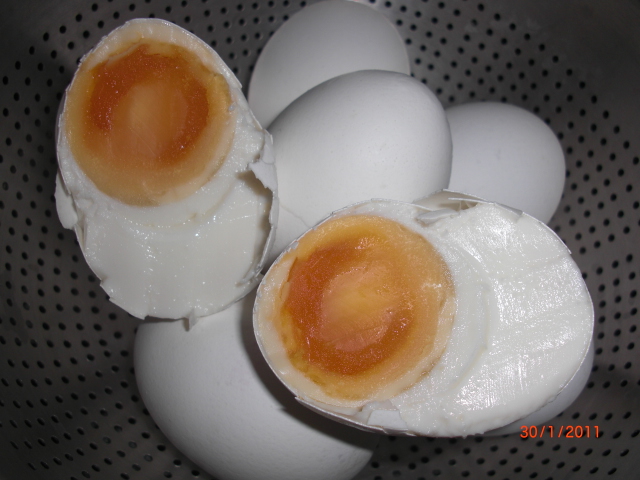
Salted egg or itlog na maalat in Tagalog is a hard boiled egg that is salty and used for decorating bibingka or partnered with fried meals. There are two ways of making salted egg. One is by use of saline solution and the other by packing it under charcoal / mud / salt mixture. Duck eggs are normally used for this process due to its thicker shell as compared to that of the chicken eggs. Filipinos living abroad have not much access with duck eggs so chicken eggs are much preferred and has a much shorter time of preparation.


Salted eggs. Photo by SDeluz

Popular Production Method in Philippines

A popular method for processing salted eggs in the Philippines is the Pateros method. The salted egg is prepared Pateros style by mixing clay (from ant hills or termite mounds), table salt and water in the ratio of 1:1:2 until the texture of the admixture becomes smooth and forms a thick texture similar to cake batter. The fresh eggs are individually dipped in the admixture, and packed in 150-egg batches in newspaper-lined 10x12x18 inch wooden boxes (often residual boxes of dried fish packing). The whole batch is then lightly wrapped in newspapers to slow down the dehydration process.

The eggs are then stored indoors at room temperature over the next 12 to 14 days to cure. This way the salt works its way into the eggs uniformly in the batch. Curing can last up to 18 days, but that results in very long-lasting red eggs that can have a 40-day shelf life, which is largely unnecessary, as the eggs are stocked and replenished biweekly.

After the two-week curing period, the eggs are hand-cleaned with water and a brush and prepared to be boiled in low heat for 30 minutes. Time is measured from the first moment the water boils and the immersion of the eggs. The 50-egg batch is then wrapped in fish nets for ease of removal from the cookware. The cookware must be large enough to accommodate the batch with a two-inch covering of water.

Chicken eggs may be processed the same way, although up to 10% of the batch can break during the process.

I used chicken eggs in this recipe. Make sure to store them in a clear jar so as to see if any cracks will form. Cracked eggs in a mixture will result in too salty egg. 

Ingredients:

a dozen chicken eggs
salt
4 cups of water

Procedure:

1. Add salt to boiling water

2. Stir while continuously adding salt. Saline solution is done if salt added will no longer dissolve.

3. Let cool. 

4. Arrange all eggs in a jar. Pour in the cooled, strained saline solution into the jar. 

5. Cover tight and leave in the pantry for 7 days. Test one by cooking to see if it is ready. If not, continue to steep a few days longer. As soon as one is ready, remove the rest and leave in the fridge but not for long though.


Enhanced by Zemanta

Bibingka (Galapong)

Bibingka is a delicacy in Philippines that is tangent with Christmas. It is normally sold on the street during Simba De Gallo together with puto bumbong and tsaa. Simba de Gallo is the sixteen days of early morning mass before Christmas eve. Back in my town, Imus Cavite, we're blessed with a special shop that offers this delicious delicacy everyday for 365 days a year. I remember stopping by the store ordering this after every Sunday mass with my family.

Bibingkang Galapong for Easter. Photo by SDeluz

There's a number of bibingka recipes out there that is easy to make. This is one of those with the exception that it is made of galapong. milled glutinous rice is known as galapong. Milling - that is, washing and soaking the rice first, and then proceeding to milling proper - is generally preferred as this removes the unpleasant powdery texture found in glutinous rice which has been dried first and then converted to flour.

Ingredients:

2 eggs
1 cup coconut milk 
3/4 cup sugar 
1/8 cup melted margarine 
1 cup rice flour 
1 tablespoon baking powder 
1/4 teaspoon salt 
banana leaf for lining

For topping:
1/4 cup coconut milk
1/4 cup sugar for topping
butter
1 salted egg, sliced crosswise

Procedure: 

1. Add sugar to melted margarine. Mix until creamy. 

2. Add beaten eggs to the mixture.

3. Combine salt and flour, baking powder in a separate bowl; add to egg mixture alternately with the coconut milk.

4. Add melted margarine, coconut milk, and baking powder. 

5. Pour into banana leaf-lined mold. 

6. Bake in 375 degrees Fahrenheit (200 deg C) for 10 minutes.

7. In the meantime, mix coconut cream and sugar in a bowl.

8. After 10 minutes, take it out from the oven and brush top with butter. Layer with salted eggs. Spread the coconut milk and sugar mixture next. Return in the oven and bake for another 10 minutes.

9. Again, take it out from the oven and distribute dessicated coconut on top. Return in the oven and bake until golden crust is formed or toothpick inserted comes out clean.

Tip: In using banana leaf for the mold, make sure to cut out the middle hard part of the leaf. You can use hair dryer in molding the leaf in the pan.


For the recipe of salted egg or itlog na maalat, click here.


Enhanced by Zemanta

Tuesday, April 19, 2011

Squid Sisig

Calamari+Fritti+-+The+Grill%2C+Grossi+Florentino+set+menu
Squid sisig. Photo by stu_spivack

Its Holy week and if you're craving the ever famous sisig of the Philippine Islands, then try this sisig using squid. You will still be enjoying the same sizzle plus still abstaining from meat.

Ingredients:

1 kilo Squid
2 Big Onions
Chilli Peppers (red or green)
Salt and Pepper
2 tbsp corn oil
Calamansi juice (lemon juice)

Procedure:

1. Grill the squids, remove the plastic of the squids after they are grilled.

2. Chop the squids and set aside.

3.Chop Onions, ginger and chillis.

4. In a pan put oil and saute' onions and ginger then add the chopped squids with calamansi juice, salt and pepper. 

5. Pour the cooked squid sisig on a sizzling plate and serve it while it sizzles.

Enhanced by Zemanta

Humba

Humba

Humba recipe. Photo by digipam

I first encountered humba when I visited the province of Catanduanes. It looks like adobo but sweeter. It is also not sliced into bite sized pieces but was a hock part of pork. Little bit oily for my taste but it is a special meal done for special occasions. 

Ingredients:

1 lb. pork
1 cup water
3 cloves garlic, crushed
1/3 cup vinegar
1/4 cup packed brown sugar
1/4 cup soy sauce
2 bay leaf
1/4 tsp. pepper or 1 tsp. peppercorns
1 tsp. oil
salt to taste
3 potatoes, peeled and quartered (optional)
hard-boiled eggs (optional)

Procedure:

1. Combine all ingredients in a big pot and bring to a boil. Lower heat and simmer for about an hour or until pork belly or hocks are tender.

2. Fry potatoes in a separate frying pan and add to the pork once nearly done.

3. Add the hard boiled eggs before serving.


Enhanced by Zemanta

Saturday, April 16, 2011

Beef Sisig

Sisig+%28Bayombong%2C+Nueva+Vizcaya%29


Sisig is normally consistent with pork. History even points out its origin in Angeles City, Philippines. Lucia Cunanan of Angeles City has been credited with inventing sisig. The Philippine Department of Tourism has acknowledged that her "Aling Lucing's" restaurant had established Angeles City as the "Sisig Capital of the Philippines" in 1974. Cunanan's trademark sisig was developed in mid 1974 when she served a concoction of boiled and chopped pig ears and cheeks seasoned with vinegar,calamansi juice, chopped onions and chicken liver and served in hot plates. Today, varieties include sisig ala pizzailo, pork combination,green mussels or tahong, mixed seafood, ostrich sisig, spicy python, frog sisig and tokwa't baboy, among others.
Here is the queen of sisig herelf Lucia Cunanan fondly knowns as Aling Lucing , talking about how sisig came about.


For those icky with using porks ears, snout and brain as part of their recipe, beef is a good alternative among others.

Ingredients:
1 pound of sirloin or rib-eye beef
onion 
dash of soy sauce
lemon juice or calamansi
1/4 cup vinegar 
egg (optional)

Procedure:

1. Option A
  • Put beef in the oven at 350 degrees fahrenheit (175 deg C) and cook it for an hour. 
    Option B
  • Boil beef in water with salt and pepper plus onion wedges. Cover and let boil for an hour. Then grill.
2. Chop up the onion and jalapeno peppers into small pieces.

3. Likewise, chop the beef into bite sized pieces.

4. In a heated pan, saute onion and beef. 

5. Add in vinegar, dash of soy sauce for coloring plus salt and pepper to taste.

6. Toss in jalapeno peppers and serve immediately while warm.

For additions: If using sizzling plate, you can crack an egg on top and mix together with calamansi or lemon juice. 


For pork sisig recipe, click here.


Enhanced by Zemanta

Pork Sisig

Sisig+%28Bayombong%2C+Nueva+Vizcaya%29


Sisig also refers to Sizzling sisig, a Filipino dish made from parts of pig’s head and liver, usually seasoned with calamansi and chili peppers. It is a constant companion of beer and thus a good "pulutan" due to its oily contents. 

Preparing sisig comes in three phases: boiling, broiling and finally frying. A pig's head is first boiled to remove hairs and to tenderize it. Portions of it are then chopped and grilled or broiled. Finally, it is fried with onions and served on a sizzling plate. Variations of sisig may add any of the following: eggs, ox brains, chicharon (pork cracklings), pork or chicken liver, and even mayonnaise. Recently, local chefs have experimented with ingredients other than pork such as chicken, squid, tuna and even tofu.

Ingredients:

1-1/2 lbs pork cheeks (or 2 lbs deboned pork hocks)

1/2 lb beef or pork tongue
1/2 lb beef or pork heart
1/2 lb liver (pork, beef or chicken)
2 cups water (for boiling)
1 cup pineapple juice (for boiling)
1 tsp whole black peppers (for boiling)


1 cup chopped onions
3-4 finger hot peppers (siling labuyo) (seeded and chopped)
1/4 cup vinegar
1/4 cup calamansi juice (lemon juice)
1/4 cup pineapple juice
1 tbsp minced fresh ginger
1 clove garlic, minced
1 tsp whole black pepper (crushed)
1 pc bay leaf (crushed)
Salt to taste

Procedure:

1. Combine pork cheeks (or deboned pork hocks), heart, and tongue in pineapple juice, salt, water and crushed whole black pepper and bring to a boil; simmer for about 1 hour or until tender.

2. Drain and cool to room temperature.

3. Slice pork cheeks/hocks, liver, heart and tongue, into 2″X3″ X 1/4″ thick pieces.

4. Place in bamboo skewers and grill over charcoal briquettes until pork rind is crisp and browned.

5. Chop the grilled pork cheeks/hocks, liver, heart, and tongue into 1/4 inch sized cubes.

6. Mix the chopped meat with the marinade seasoning mix of garlic, ginger, onions, vinegar, calamansi (lemon) juice, hot peppers (siling labuyo), bay leaf, salt and pepper.

7. Keep the marinated mixture in the refrigerator for 2-3 hours before serving.

It is a tasking recipe but worth the wait.
This is a video in Tagalog. A different version of pork sisig with tofu. Don't mind the background music. 


This one has an Englisg subtitle. Much easier to follow. 


This one is done first in the oven which is the same as that of our beef sisig recipe.


Enhanced by Zemanta
Related Posts Plugin for WordPress, Blogger...